Haskamot | Endorsements
Rabbi Reuven Lauffer
Senior Lecturer, Ohr Somayach, Jerusalem
I have had the distinct pleasure of knowing Benny Leshin since he came to learn in Ohr Somayach. His presence adds an immeasurable dimension to our shiur and his questions and insights are deep and always relevant. Benny is a testimony to the famous words of Rabbi Chanina, Tractate Ta'anis 7a, "Much have I learned from my rabbis, even more have I learned from my colleagues, but from my students I have learned more than from anyone else." And now Benny has authored a thought-provoking and startlingly accurate composition called The Age of Disconnection. As its title implies The Age of Disconnection is a journey of discovery. In it Benny skillfully describes and defines what it is that holds a person back from living a more meaningful and consequential life... and introduces the reader to a new world that is comprised of infinite spiritual dimensions just waiting to be uncovered. I have been sitting quietly at my computer for a little while, reflecting on what I have just read. I am awed and inspired by Benny's thoughts. What he has written is so deep and yet so incredibly accessible... so deep and yet so clear, so deep and yet so simple. Hashem should bless you with success in all your endeavors!

Kol Tuv,
Rabbi Reuven Lauffer
Rabbi Reuven Lauffer
Rabbi Reuven Lauffer is a senior lecturer at Ohr Somayach in Jerusalem, where he has been teaching for well over thirty years, inspiring students from around the world. He is widely respected worldwide as an educator, public speaker, and a huge contributor to Ohr Somayach’s weekly publication, Ohrnet.
Rabbi Yaakov Bach
Founder of The Tefillin Project | Community Leader & Author
It is a true privilege to write these words about the meaningful and thought-provoking work, Protected: The Age of Disconnection, authored by Benny Leshin.
Having known Benny for many years, I can personally attest that he is a genuine seeker of truth, an impressively deep thinker, and a person of refined character—qualities that shine clearly throughout this sefer. Each sentence is packed with tremendous depth. With remarkable clarity, presented in a concise and accessible format, he addresses one of the most pressing challenges of our time: how modern technology has quietly yet profoundly impacted our connection to ourselves and our inner world. In a world filled with constant noise and distraction, this work offers something rare—it invites us to pause. Benny helps the reader step back, reflect, and honestly examine how easily we’ve lost touch with stillness, focus, and our deeper selves. He gives words to something many of us feel but struggle to articulate. One of the most powerful ideas in this sefer is the rediscovery of silence. In a generation that often fears being alone with its own thoughts, Benny gently shows us how essential—and how healing—that space can be, both mentally and spiritually.
Most importantly, this is not just a critique of modern life—it is a guide. Benny reminds us that the truths he uncovers are deeply rooted in G-d’s blueprint for the world—the Torah—and he presents them in a way that feels both authentic and accessible. This is a sefer that speaks to every one of us. Anyone living in today’s world will benefit from its message. I warmly encourage you to take the time to read it—it has the power to awaken, to ground, and to inspire.

With great respect,
Rabbi Yaakov Bach
Rabbi Yaakov Bach
Rabbi Yaakov Bach is a highly respected and impactful leader in the Jewish community. Through his work, he has influenced hundreds...if not thousands...of individuals worldwide. He is the founder of the global project called "The Tefillin Project," through which over 250+ pairs of Tefillin have been distributed across multiple countries. He is also the driving force and founder of several different successful projects such as P.O.T. and 25 for 25. He is also an author, continuing to impact others through his expertise and leadership.

Prologue: The Silence Beneath the Noise
In the beginning, man listened.
He listened to the wind move through the trees,
to the river speaking in secret tones,
to the silence between his own heartbeats.
In that stillness, the world was alive.
Every sound was a message, every moment a teacher.
The soul heard itself reflected in creation
and knew it belonged.
Time turned, man learned to build.
He filled the air with towers, signals, and light.
He could fly like eagles fly.
He could speak across oceans.
He called this connection
and in doing so, forgot what connection was.
Never been so reachable,
and yet sitting so far.
The Mind drowns in information,
the Heart aches in quiet hunger,
the Soul… once radiant
waits beneath the static for someone to remember the song.
We touch everything, but feel nothing.
We speak constantly, but say little.
We see everyone, yet know no one… not even ourselves.
We have gathered the world’s knowledge into our palms,
yet the heart remains unlearned.
Wisdom has grown silent beneath the noise.
Still, somewhere beneath,
a pulse remains.
A quiet whisper in the machinery.
We are not human doings… we are human beings.
To be is the oldest commandment.
To be still is the beginning of understanding.
For in that silence, the Divine still speaks.
And to those who listen… all things are revealed.
Return.
Scroll I — The Disconnection of the Mind
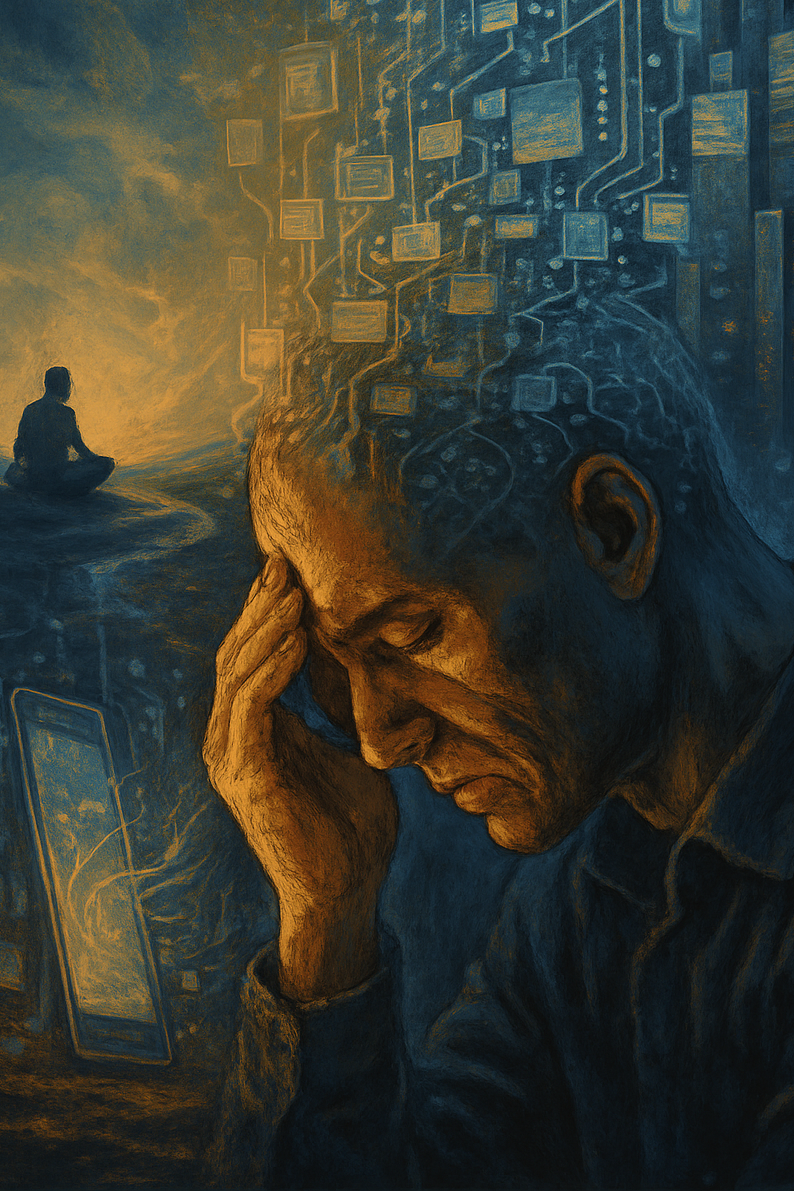
In the ancient world, silence was a teacher.
Men would wander into deserts,
sit beside rivers,
and listen until their own thoughts became clear.
But the modern mind has forgotten how to listen.
It has become a restless machine
fed by constant noise,
rewarded by distraction,
terrified of stillness.
We have mistaken stimulation for knowledge,
and motion for progress.
The mind no longer reflects, it reacts.
It does not dwell in thought, it drowns in it.
We summon worlds through a screen.
A flick of the finger and creation reshapes itself.
We possess infinite information,
yet understand almost nothing.
The brain is full, but the soul is starving.
Scroll through infinity,
but cannot sit still for a single truth.
Built towers of data,
but lost the wisdom that once made sense of them.
Ancient wisdom called this forgetting galut ha’da’at
the exile of awareness.
When the mind leaves its sacred center.
A State of spiritual disorientation, confusion, or a profound loss of clear perspective and connection to one's core spiritual identity.
Leading to a focus on external concerns at the expense of internal or communal well-being.
Modern science calls it dopamine addiction.
The sages called it idolatry.
The mind was never meant to chase noise
it was meant to shape meaning.
It was not created to devour every signal,
but to discern the one that leads home.
When the mind is enslaved to distraction,
it cannot hear the whispers of the heart
or the breath of the soul.
The world becomes fragmented
and so does man.
But within the silence we fear most
lies the voice we have been running from.
And if we listen long enough,
we will find that stillness is not emptiness
it is the sound of the Mind returning.
Scroll II — The Disconnection of the Heart
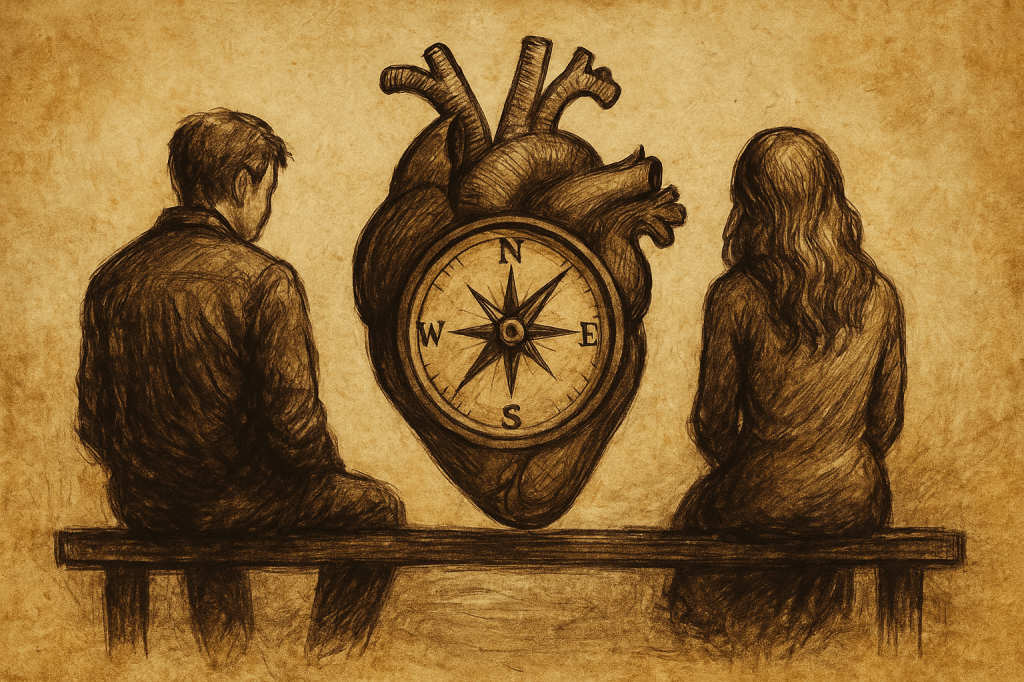
The Heart was once the compass of man.
It did not speak in logic or language,
but in rhythm… a truth beyond words.
Before we built systems and screens,
We built altars of trust.
We looked into eyes and knew stories.
We listened not to reply, but to remember.
And in that remembering, love was born.
But in this age, the Heart has been exiled.
We have taught ourselves to feel less,
to turn pain into performance,
to replace being known with being noticed.
We measure love by response time,
friendship by followers,
and worth by material success.
The Heart beats still, but beneath armor.
It yearns to be touched, not scrolled past.
It cries out to be seen, not summarized.
Empathy has become fatigue.
Compassion has become content.
We perform authenticity while starving for it.
The ancient sages taught:
“More than anything else, protect your heart, because it is the fountain of life” (Proverbs 4:23).
But how can we guard what we no longer visit?
How can we love what we no longer feel?
Modern Science has demonstrated, through empirical evidence,
that isolation wounds deeper than hunger,
and that connection… real love
heals not only the soul, but the cells themselves.
The Heart is not weak.
It is the strongest of all instruments.
But strength without vulnerability becomes stone,
and we were not made of stone.
The world will heal not through intellect or invention,
but through the return of the Heart.
Through presence.
Through tears that cleanse instead of hide.
Through hands that hold without agenda.
Through silence shared between two souls who remember…
They are not alone.
For in every act of true love,
the Heart reawakens
and through it, the world remembers how to feel again.
Scroll III — The Disconnection of the Soul

Once, man walked with wonder.
He looked upon the sunrise and whispered prayers,
not because he was told to,
but because his soul could not stay silent before beauty.
There was a time when the sacred was not distant
it lived in the ordinary.
A loaf of bread was a blessing.
A breath was a miracle.
To live was to participate in creation itself.
But as the world grew louder,
the voice of the Soul became a rumor.
We began to replace reverence with routine,
faith with philosophy,
meaning with measurement.
We began to ask not why we live,
but how much we can get from living.
The Soul became a forgotten language
ancient, quiet, and inconvenient.
Man built heavens of metal and light,
but none that could hold his spirit.
He sought eternity in machines,
and found only repetition.
Science, for all its brilliance,
can tell us how the stars burn
but not why they shine.
It can map the brain’s electricity,
but not the fire that dreams within it.
The Soul does not speak through proof.
It speaks through presence.
Through silence.
Through the ache that reminds you there is more.
And yet
even when buried beneath disbelief and distraction,
the Soul does not die.
It waits.
Patient, eternal, uncorrupted.
It waits for a moment of stillness,
a single breath of surrender,
a whisper of “enough.”
In that moment, something ancient stirs.
The exile ends.
The Soul returns home.
And in its light, every question you carried
is transformed into awe.
Scroll IV — The Sacred Power of Stillness

Before the Torah was given, there was Sinai.
A mountain wrapped in thunder, flame, and awe.
And yet, within that thunder, there was a deeper silence.
A silence so complete that all creation held its breath.
Said Rabbi Abbahu in the name of Rabbi Yochanan:
When the Holy One gave the Torah, no bird screeched, no fowl flew, no ox mooed, none of the ophanim (angels) flapped a wing, nor did the seraphim (burning celestial beings) chant “Kadosh Kadosh Kadosh (Holy, Holy, Holy!)” The sea did not roar, and none of the creatures uttered a sound. Throughout the entire world there was only a deafening silence as the Divine Voice went forth speaking: “Anochi Adonai Elohecha, I am ha-Shem your God” (Midrash Shemot Rabbah 29:9).
They say the people saw the thunder
for the revelation was not heard with ears, but with the soul.
The first sound of creation returned
not noise, but presence.
Not speech, but the silent letter Aleph of “Anochi,” the word “I Am” (Midrash Shemot Rabbah 29:9/Shemot 20:2).
It was not a shout from heaven,
but a still whisper that awakened the universe.
And that whisper still lives within you.
Yet man has forgotten the feeling of that stillness.
He fills his mind with echoes,
his heart with noise,
his life with endless motion.
He runs not toward peace, but away from it,
for he cannot face the battlefield within his own mind.
When filled with constant noise, the mind is a storm.
The body is its vessel.
The soul… the eternal witness
waits beneath the waves, patient, watching.
When man turns inward, the storm rages.
Every fear he’s buried rises to the surface.
Every thought he’s ignored demands to be heard.
That is why he fears silence
because silence shows him who he truly is.
The Torah called it the midbar — the wilderness.
Not a place of punishment, but for purification.
40 long years traveling through the Desert.
For in the desert, where the world falls silent,
a person can finally hear himself,
and in hearing himself,
he discovers the One who was whispering beneath every step.
Scroll V – The Discipline Of Quiet Power

“Say little and do much” (Pirkei Avot 1:15).
The sages understood something the world has forgotten:
that power does not need to announce itself.
Noise makes promises.
Stillness keeps them.
True strength does not rush to speak,
for speech leaks energy before action has taken form.
It gathers itself inward,
where intention ripens into clarity.
The world believes force is loud.
The Torah teaches otherwise.
“Not by might, nor by power, but by My Spirit, says the Lord of Hosts” (Zechariah 4:6).
Not by conquest.
Not by domination.
Not by the pressure of will.
But by alignment.
For the Divine does not dwell in thunder or flame, but in the kol demama daka — the still, thin voice that follows (I Kings 19:12).
It is not the storm that reveals truth,
but what remains when the storm passes.
This is the discipline of quiet power:
to restrain before acting,
to turn within before deciding,
to align before moving.
The sages taught that one who speaks too quickly
reveals that his thoughts have not yet settled.
For wisdom descends only where there is space to receive it.
Action that emerges from silence carries precision.
Action born of haste fractures.
To rush is to force outcomes.
To be still is to allow the path to reveal itself.
This is why the Torah praises menuchah (inner rest), not as withdrawal,
but as mastery.
The strongest person is not the one who exerts the most force,
but the one who knows when force is unnecessary.
Not shouting at the world,
but listening deeply enough
to move in harmony with it.
For when action is guided by stillness,
it does not collide with creation…
it completes it.
Scroll VI: The Ancient Power of Silence.
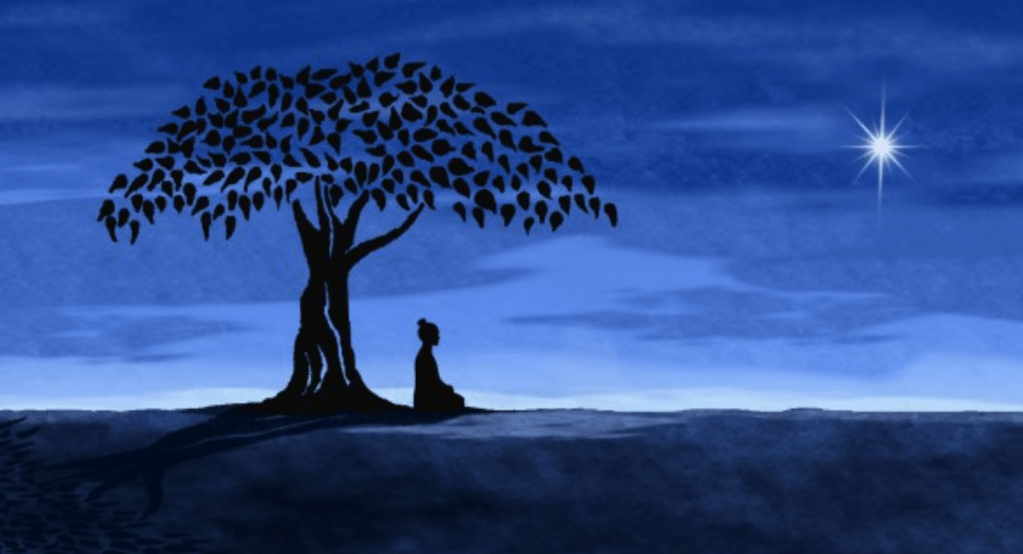
In the Tehillim it is written,
“Be still, and know that I am God” (Tehillim 46:11).
The sages taught that creation was not born from chaos.
It was born from the pause between chaos.
It is in that pause that form takes shape, that thought becomes world.
Described in the Midrash, for the world was created in silence (Bereishit Rabbah 3:1).
The mystics called it Ayin — the nothingness that is not empty, but full of divine potential.
In that nothingness, all sound sleeps, all energy waits.
To the ancients, silence was not the absence of noise; it was the presence of everything unspoken.
It was the field where the infinite hid its face.
The philosophers knew this too.
Socrates said that wisdom begins in wonder, and wonder is born in quiet.
Lao Tzu wrote that the Tao does not speak, yet it guides all things.
The desert fathers, the monks, the mystics… They fled the markets not because they hated the world,
but because they knew that silence was the language of truth.
Neuroscientists have found that silence reshapes the brain
that quiet time each day can regenerate neurons in the hippocampus,
the very place where memory and imagination live.
The ancients called it revelation; moderns call it restoration.
“All my days I have been raised among the Sages and I found nothing better for oneself than silence” (Pirkei Avot 1:17).
Silence, then, is not weakness… it is power.
It is not retreat… it is return.
In silence, the mind untangles, the heart listens, the body slows,
and the soul remembers its original language.
The body, the ancient messenger, keeps the score.
Anxiety, depression, exhaustion, sleeplessness… the symptoms of a world without rest.
The nervous system trapped in endless alert,
the soul pacing like an animal in a cage of its own making.
Modern science confirms what ancient faith already knew:
that the mind without silence begins to fray.
Cortisol rises, empathy declines, creativity withers.
Noise is not neutral… it is corrosive.
It eats the edges of attention until nothing sacred remains.
And yet, the remedy has never changed.
It was written into the design from the very beginning: Shabbat.
A covenant of quiet.
A divine command not to produce, not to strive, not to work
but simply to be.
For silence is not withdrawal from life… it is return to it.
It is not escape from the world… it is reunion with it.
It is the place where the spirit exhales.
Scroll VII — Shabbat: The Stillness of Completion
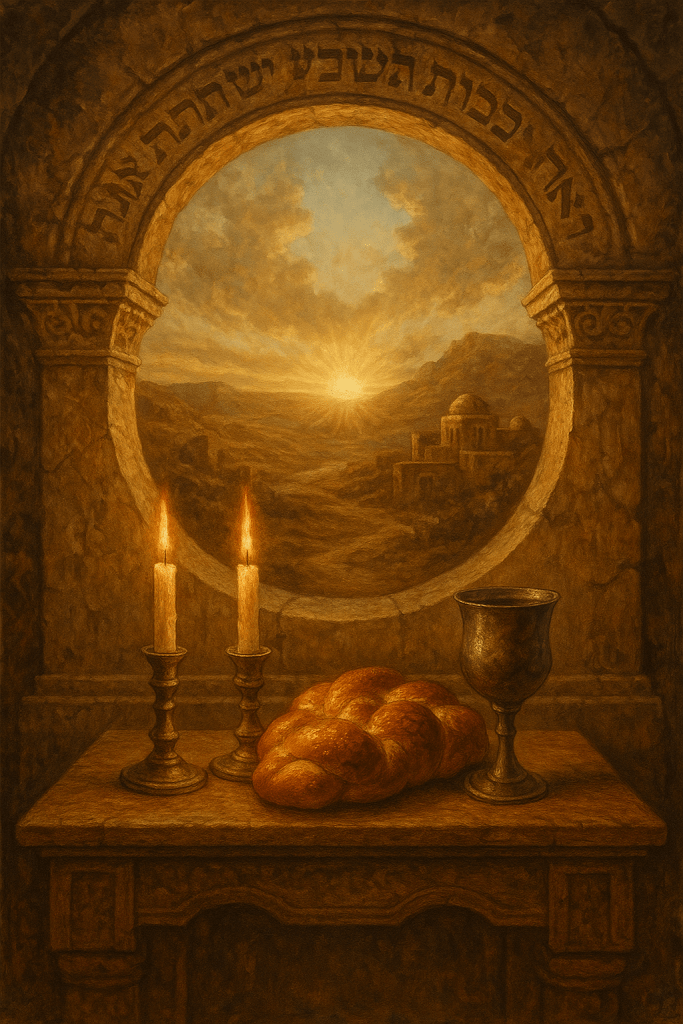
In the beginning, God created through speech
six days of sound, motion, and becoming.
But on the seventh, He completed through rest.
For on the seventh day, God finished His work and He rested, blessed it, and sanctified it (Bereishis 2:2–3).
The sages taught: What was the world lacking?
Rest. When Shabbat came, rest came, and the work was complete.
What was created on Shabbat after the creator rested from creating the world?
Tranquility, satisfaction, calm, and quiet (Bereshit Rabbah 10:9).
It is not a day of doing less, but of becoming whole.
A weekly return to the stillness that birthed creation (Shemos 20:8–11).
On Shabbat, the tools of the world fall silent.
Even in plowing and harvesting you shall rest, you shall not kindle fire; your servants, stranger, and animals rest as well (Shemos 34:21; Shemos 35:3; Devarim 5:13–14).
Business, too, yields before holiness: the prophets and leaders rebuked buying and selling on the Sabbath and taught to honor the day by not pursuing one’s own affairs nor speaking weekday matters (Nechemiah/Nehemiah 13:15–22; Yeshayahu/Isaiah 58:13).
Each week Shabbat descends like a whisper from eternity
reminding us: You are not your labor, You are not your striving.
You are made b’tzelem Elohim — ‘in the image of God’
Not Merely in form, but in essence.
To reflect eternity, not to produce without end (Bereishis 1:27).
And when the candles are lit and the world grows quiet,
a different light fills the room
a remembrance of the Ohr HaGanuz, the first light of the creation, which our sages taught was set aside for the righteous (Rashi to Bereishit 1:4, citing Chagigah 12a & Bereishit Rabbah 3:6).
This is the bridge between heaven and earth,
between chaos and calm,
between doing and being.
Shabbat teaches that peace is found not by addition, but by release.
Six days we create the world,
On the seventh, we let the world be whole.
Epilogue — The Return to Wholeness
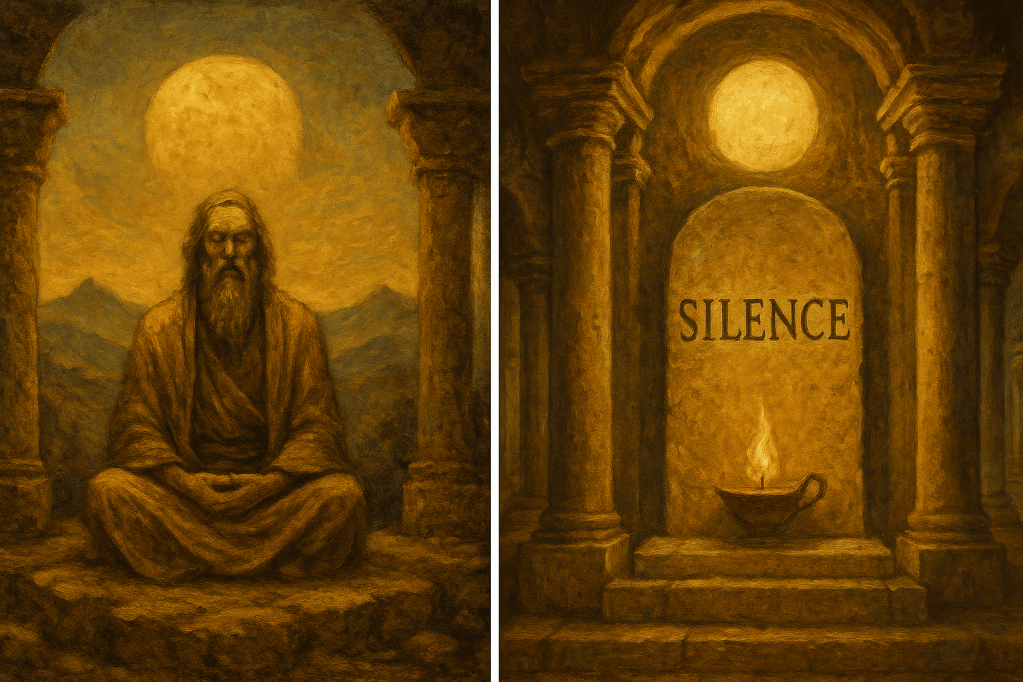
There was once a time when silence was the sanctuary of prophets,
where voices did not shout, they listened.
Where wisdom did not echo, it arrived.
Where the still mind became a mountain upon which truth could descend.
The night cannot swallow the dawn forever.
Even now, in the noise and neon,
there are hearts beginning to listen again.
The silence we feared has become our salvation.
For beneath all the chaos,
there still beats the pulse of something ancient
the same rhythm that began it all.
It calls us not to invent a new world,
but to remember the one we lost.
Not to escape our humanity,
but to return to it.
We begin not by changing the world,
but by rebuilding the altar within.
One breath.
One thought.
One act of love at a time.
The Mind must learn again to be still
The human being must again learn to be.
The Heart must learn again to open
to feel without fear,
to love without needing to be seen.
The Body must remember it is sacred
a vessel of divine intention,
not a prison of flesh.
And the Soul
it must rise once more to its rightful place,
as the fire that gives life to all the rest.
These are not ancient commands,
but timeless coordinates
the map home, written into the design of man.
If we restore what is within,
the world will follow.
The cities will breathe again,
the children will dream again,
and the silence between hearts will become song again.
For connection was never lost
only forgotten.
And to remember is to be reborn.
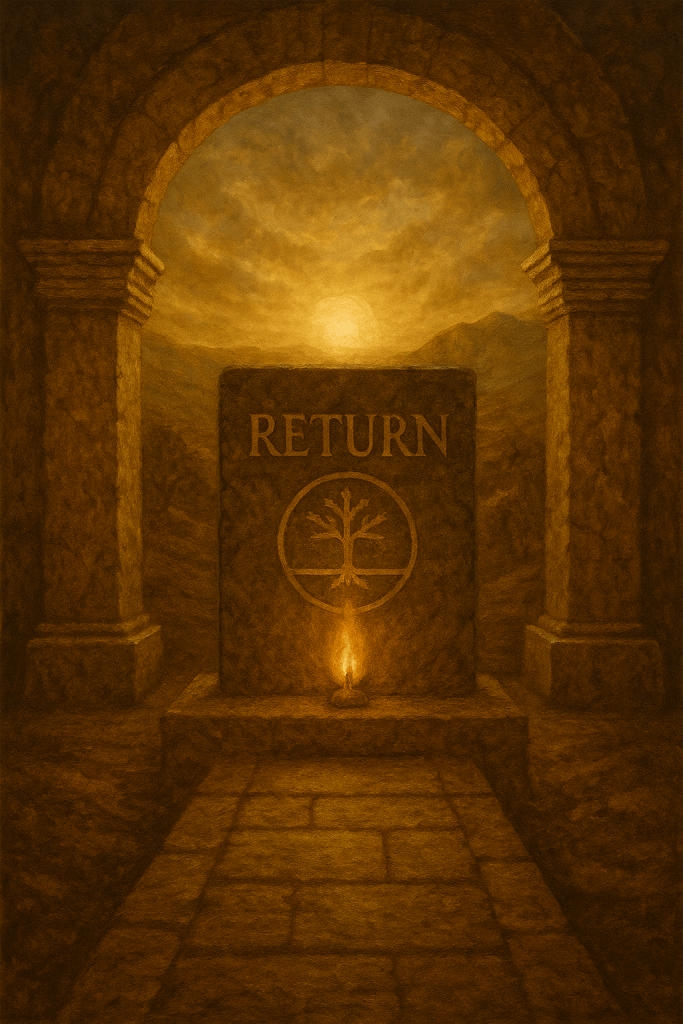
“Return,” says the whisper.
Return to the Source.
Return to the balance.
Return to yourself.
And when man finally listens…
When the Four Pillars: The Mind, Body, Heart, and Soul stand once more in harmony…
heaven and earth will hum again as one.
– Words By Benny Leshin









Leave a Reply